I had the pleasure of attending an event where Andre delivered an outstanding talk on leadership & workplace culture.

TrustLytics®
The financial diagnostic tells you where the leak is. TrustLytics® helps you stop it.
The Financial Diagnostic shows you where you think margin is leaking, and what that's likely costing.
TrustLytics® brings in your team's actual experience, shows you where it diverges from yours, and closes that gap, one precise adjustment at a time.

Where the leak actually happens
Most firms don't lose margin in one obvious place. It leaks in small amounts, across ordinary moments, for example, a piece of work redone, a request left unanswered, a discount agreed without anyone asking why. None of it looks like a crisis but all of it adds up.
Why it stays invisible
Imagine you are driving a car.
You can see everything through the windscreen. The road ahead is clear. You check your mirrors. Everything looks fine. You are a good driver. You are paying attention.
But every car has a blind spot. A place the mirrors cannot reach. A space just out of view where something can be present without you knowing it is there.
You are not a bad driver because you have a blind spot. Every car has one. It's built into the design.
The danger is not knowing it's there and making decisions as though everything in it does not exist.
Leadership works the same way
You know yourself well. You understand your values, your strengths, and how you like to lead. You are experienced, self-aware, and paying attention.
But every leader has a blind spot. The space between how you see yourself and how you are actually experienced by the people around you. The conversation your team is not having with you. The pressure your most reliable people are carrying without raising it. The gap between how you intend to lead and how it actually lands.
You are not a bad leader because these things exist. They exist in every firm. They are built into the nature of leading from the front.
The danger is leading with confidence in a picture that is missing half the detail.
The risks of not surfacing blind spots
Most blind spots do not announce themselves. They grow slowly: one small exception that becomes the norm, one signal that gets absorbed rather than acted on or one conversation that never quite happens.
Nothing appears dramatically wrong because the firm is functioning, billing and growing, until the cost becomes impossible to ignore.
Write-offs quietly accepted for months become the year's most significant margin problem. A top-quality fee earner carrying too much for too long hands in their notice taking client relationships and institutional knowledge with them. A matter runs significantly over budget because nobody flagged the scope creep early enough.
None of these are sudden failures. They are the accumulated cost of decisions made without a complete picture.
The numbers tell the story
The average law firm realisation rate is 88%, meaning roughly 12% of potential revenue never makes it onto an invoice. That's work done, but never billed.*
Nearly 90% of firms reported increased write-offs in 2025, with 88% expecting them to rise again in 2026.
Headline growth is masking a margin problem that most firms can feel but can't pinpoint.
These aren't industry anomalies. They're the financial footprint of operational patterns that were present long before they showed up in the figures.
The question isn't whether your firm has blind spots. It's what they're costing you while you can't see them.
That's why we built TrustLytics® — to make the invisible visible, and give leaders the precision to adjust early, before small issues become expensive ones.
*Source: Clio 2024 Legal Trends Report. **Source: BigHand 2026 Law Firm Finance Report.
What you get from TrustLytics® is visibility into blind spot risk. Leakage you can recover.
How TrustLytics® works
TrustLytics® runs in two stages. The Financial Diagnostic gives you the first half of the picture. TrustLytics® completes it.
Stage 1 - Financial Diagnostic - How you read the situation
The free Leadership Diagnostic surfaces which patterns are present and gives you a clear indication of where they may be affecting billing, retention and team performance.
Stage 2 - Full Diagnostic - How your team experiences the situation
TrustLytics® brings in anonymised team-level data on how these situations are actually experienced by the people around you. The gap between Stage 1 and Stage 2 is where the blind spot actually lives.
The Calibration programme
Once the blind spot is identified and measured, the calibration programme begins. These are focused 1:1 sessions — 30 minutes, delivered in person or remotely designed to help you make small, precise adjustments where they matter most.
This is not a training programme. There are no techniques to learn, no frameworks to adopt, and no disruption to client work. The sessions work directly with live matters not hypothetical exercises.
What you can expect
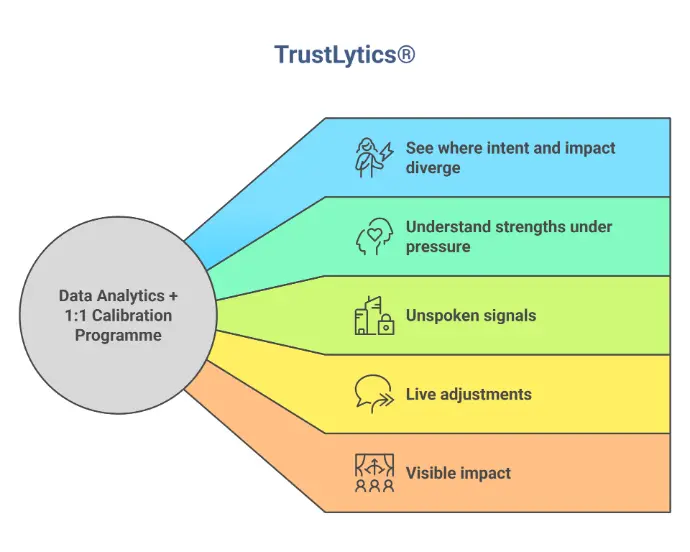
See where your read diverges from your team's experience
You'll identify the specific situations where what you intended didn't land as expected, and understand why that gap tends to widen under pressure and seniority.
Understand how effective patterns become expensive ones
Qualities that built your career, high standards, decisiveness, composure can quietly create operational drag when over-relied upon. You'll see exactly where that's happening and what it's costing.
Recognise the signals people send instead of speaking up
Hesitation, silence, checking, late escalation, these often replace honest feedback. You'll learn what those signals are responding to and which operational situations are triggering them.
Make small adjustments in live work
Rather than abstract discussion, you'll trial minor, low-risk shifts in real situations and observe what changes in your team's behaviour, in your own workload, and in the numbers.
See the shift in the work, not just in the room
The changes that matter show up operationally : faster escalation, more even workload distribution, better realisation. You'll track these against your baseline, not just sense them.
Who this is designed for
TrustLytics® is built for law and accountancy firms with 25 to 250 people, where margin, delivery consistency and retention are under pressure.
Two situations in particular:
You've recently stepped into a bigger leadership role. You're now responsible for revenue, people and client relationships in a way you weren't before and the patterns that worked when you were running your own caseload may not be the ones your team needs from you now.
You know something is dragging on performance, but you can't name it. The firm is functioning, billing, growing but margin isn't following, or the same problems keep surfacing. You've tried addressing it, but without being able to see the cause clearly, the fixes don't stick.
Book your free diagnostic
About Us
I started Thomas Telman in 2015 placing solicitors in private practice as a legal recruitment consultant, however in 2019 I stopped all recruitment.
Why?
I wanted to understand why capable law firms were still struggling to attract and retain talent even when pay, work quality, and reputation were strong.
That led me to study workplace culture in law firms in depth. I interviewed dozens of managing partners, HR directors, and practice leaders to understand where leadership intent and team experience were diverging. Those insights became the foundation of TrustLytics®.
I began writing and speaking about leadership, trust and engagement across the UK including speaking at the Law Society People Conference and others including ICAEW conference on workplace culture.

Frequently asked questions
Here are some common questions about our company.
Trusted by many organisations